
LOW-BIT COMPUTE. VERIFIED WITH YOUR WORKLOAD.

Low-bit inference.
Yours to verify.

Corvel designs and licenses CV-X1 Pro and CV-GEMV RTL IP for low-bit inference. Run and verify your workload in Corvel Forge.

Runs in your browser · Zero-install evaluation · Inputs stay on your device

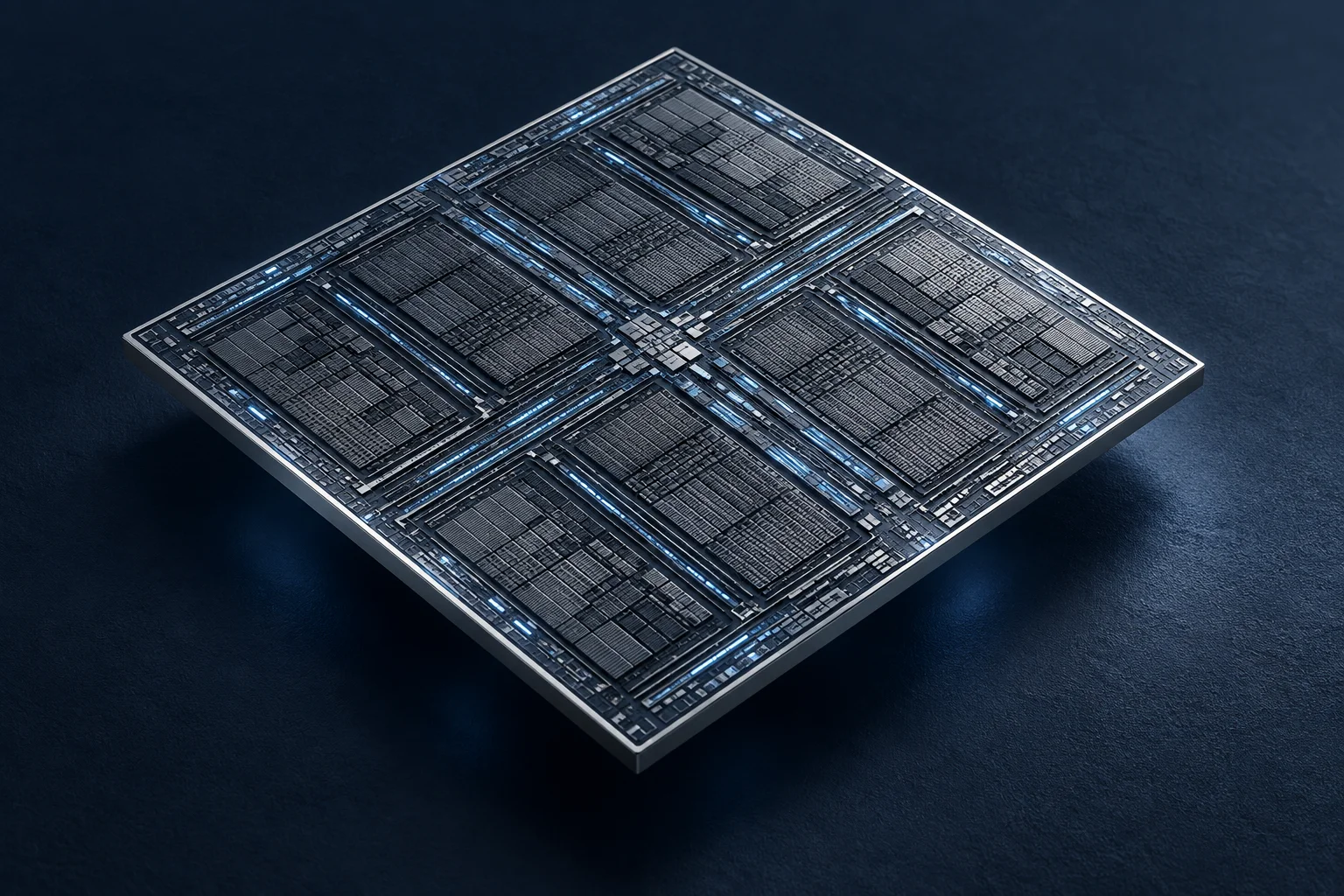
Conceptual rendering of silicon compute architecture
CV-X1 / COMPUTE SUBSYSTEMPreparing model
CORVEL COMPUTE IP
CV-X1 Pro
INT4 × INT88 LANES
REPRODUCIBLE BY DESIGN

The browser model and Icarus were cross-checked
on identical input cycles.

37
Workloads covering boundary conditions
1,060,668
Pre- and post-edge signal comparisons, every cycle
0
Semiconductor ink landscape inspired by wafers and circuit traces
Silicon, in a different light. · Corvel ink series
CORVEL FORGE

From evaluation to integration,
one continuous workflow.

Even when you adopt a compact compute block, real data and system constraints vary. Forge lets you inspect and reproduce those differences directly.

01 / CALIBRATE

Calibrate precision
to your own data.

Calibrate FP inputs into grouped INT4/INT8 formats and compare error against symmetric quantization baselines. See both where accuracy improves and where it degrades.

Compare quantization →
02 / EXECUTE

Run the circuit and
inspect internal state.

Vary inputs, backpressure, and saturation conditions to inspect actual RTL outputs and cycle counts. You can trace execution down to FIFO and pipeline state.

Run RTL →
03 / INTEGRATE

Bring results and evidence
into your development environment.

Download a testbench tailored to your inputs along with the RTL, expected outputs, and waveforms. Re-run locally to evaluate SoC integration requirements.

Build evaluation kit →
BUILT FOR A PRECISE JOB

Compact compute.
Clear integration contracts.

CV-X1 Pro is a synthesizable micro-IP for group-quantized dot products, designed as a compute block with streaming I/O and backpressure control.

CV-X1 PRO / L8

Fusing group scale
into the accumulation path.

A three-stage pipeline applies a per-group zero-point offset, performs 8-lane parallel multiplication with tree reduction, and accumulates with scaling and saturation.

STAGE 1Fetch & DequantINT4 · zero point
STAGE 28-lane MACSigned dot product
STAGE 3Scale & AccINT32 · saturation
Weight × Activation
INT4 × INT8
Group size
8 elements
Input FIFO
4 entries
On-chip register memory
256 bytes / engine

The current evaluation configuration includes flip-flop-based storage. Foundry-specific SRAM macro integration and physical design are scoped as separate project deliverables. Forge's internal requests have verified custom blocks with GF180MCU SRAM macros and AXI interfaces: verification by request.

EVIDENCE IS PART OF THE PRODUCT

Delivering the evidence
behind every number.

Every metric is linked to its exact design revision, execution parameters, and raw reports. Verification data only counts if you can reproduce it in your own environment.

Cross-checking results
with independent tools.

  • Cycle-by-cycle comparison between the browser RTL model and Icarus Verilog
  • Boundary verification across positive/negative saturation, wrap-around, and backpressure
  • End-to-end reproducible evaluation package from input vectors to outputs
Open verification evidence ↗
CURRENT EVALUATION RELEASE

Clearly stating the scope
verified through design
and simulation.

Published data covers RTL evaluation, plus synthesis and timing analysis against a standard-cell library. It does not represent measurements of fabricated silicon or a volume production history.

LET’S BUILD THE RIGHT BLOCK

Start by telling us
your compute requirements.

Share your input formats, throughput targets, memory budget, and target integration environment. We will review it with you, from evaluation kits to the scope of custom IP integration.

SoC · FPGA · Edge compute
Technical Evaluation / Joint Development / Investor Inquiries

The information you submit is used to respond to your inquiry. Privacy Notice